Vapor Barrier vs. Full Crawl Space Encapsulation
A vapor barrier is a sheet of polyethylene laid over the dirt floor, often 6 mil, with the vents left open. Encapsulation seals the whole space: a thick barrier on the floor and walls, taped seams, sealed vents and rim joists, and a dehumidifier or conditioned air to control humidity.
A barrier alone is the cheaper fix: $1,000 to $3,000 (Angi) or $1,200 to $4,000 (HomeGuide). Full encapsulation typically runs $5,000 to $15,000, with an average near $5,500 (Angi). Climate and moisture decide which one your crawl space needs.
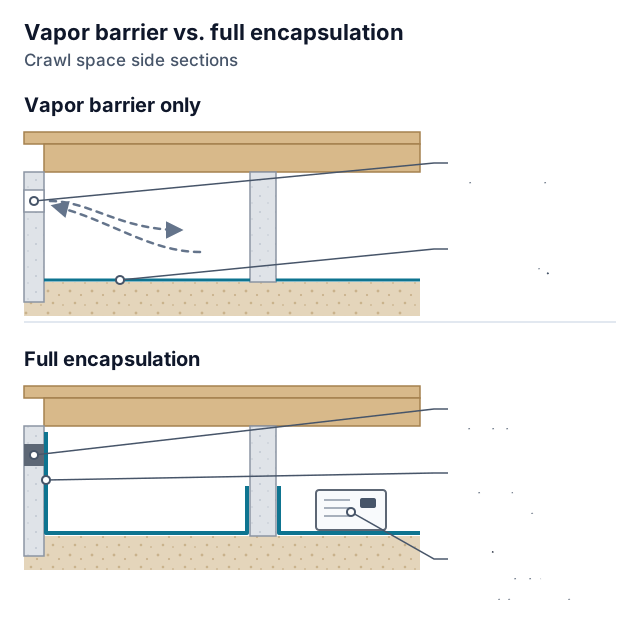
At a glance
| Vapor barrier (ground cover) | Full encapsulation | |
|---|---|---|
| What it is | Polyethylene sheet over the dirt floor, often 6 mil; vents stay open | Thick liner on floor and walls, taped seams, sealed vents and rim joists, plus a drying method |
| Installed cost | $1,000–$3,000 (Angi); $1,200–$4,000 (HomeGuide); about $2–$4 per sq ft | $5,000–$15,000, average $5,500 (Angi); $3,000–$15,000 or $3–$10 per sq ft (HomeGuide) |
| Material | $0.30–$0.70 per sq ft for 6- to 20-mil liner (HomeGuide) | Same liner, plus seam tape, vent covers and a dehumidifier ($1,000–$3,000 installed, HomeGuide) |
| Humidity control | None: outside air still moves through the vents | A dehumidifier, conditioned supply air or an exhaust fan, as code requires |
| Code (sealed space) | A floor barrier in a vented crawl space is not a closed crawl space | IRC R408.3 (or NC R409 in North Carolina): Class I vapor retarder, sealed laps, a drying method |
| Running cost | None | Dehumidifier electricity $10–$30 a month (HomeGuide) |
| Best fit | Dry climates, or homes with no moisture complaints | Humid climates: most of the Southeast, Mid-Atlantic and Gulf Coast |
When a vapor barrier is enough
In dry climates, or under homes with no moisture complaints, a quality ground cover can be all you need. HomeGuide prices barrier material at $0.30 to $0.70 per sq ft and an installed barrier at about $2 to $4 per sq ft; Angi puts a vapor-barrier job at $1,000 to $3,000.
Thickness matters for durability more than for the code minimum. North Carolina accepts 6-mil polyethylene with 12-in laps (R409.2.1). Thicker 12- to 20-mil liners resist tearing from foot traffic and service work, and cost about twice as much as 6-mil ($0.60–$0.70 vs $0.30–$0.35 per sq ft, HomeGuide).
When to encapsulate
In humid climates (most of the Southeast, Mid-Atlantic and Gulf Coast), open vents bring in summer air that condenses on cool framing. Sealing the space and drying it mechanically is the approach recommended by most building scientists for those regions.
The local numbers show why. At Raleigh-Durham International, July's average dew point is 68.7°F, and a third of all hours in a normal year have a dew point of 60°F or higher (NOAA). Encapsulation is also worth considering when you have musty odors, sagging or wet insulation, high indoor humidity, pest activity or cold floors.
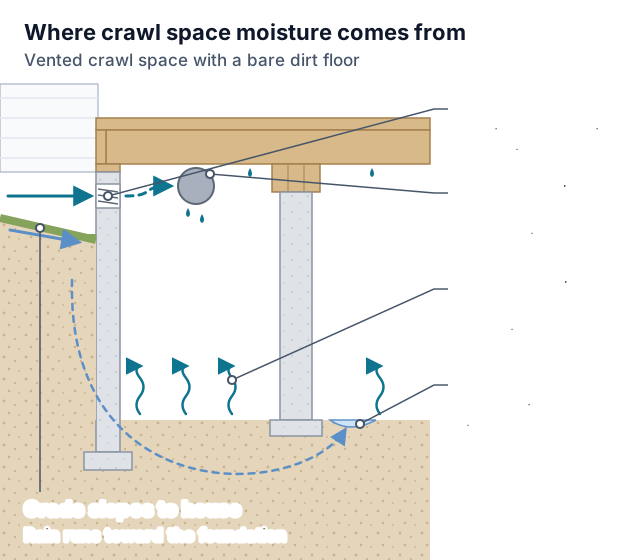
What the building code expects
Once vents are sealed, the 2021 International Residential Code (section R408.3) expects the space to be conditioned or dehumidified and the ground covered: a continuous Class I vapor retarder with sealed 6-in laps, run at least 6 in up the wall, plus one drying method. Check your local code office, since adoption varies by state.
North Carolina uses its own closed crawl space section, R409. It asks for 12-in laps, a 3-in termite inspection gap and a drain or sump at each low spot, and the state requires a permit to close a vented crawl space regardless of cost. Henrico County, VA lists encapsulation as permit work.
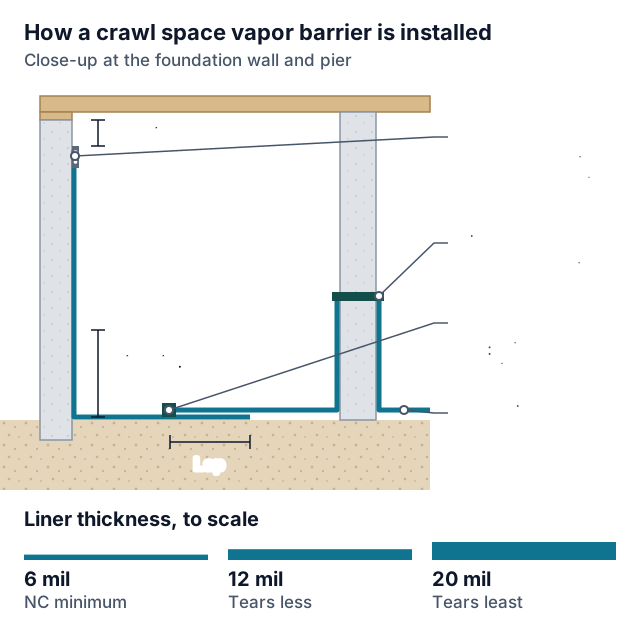
Which should you choose?
If the crawl space is dry, smells fine and the framing reads dry, a well-installed ground cover is the low-cost choice. If you see condensation, damp insulation, mold or standing water, or you live in a humid region, price full encapsulation, and fix any water or structural problems first.
Either way, ask each bidder to itemize the liner thickness, seams, vents and drying method so you can compare quotes line by line.
Frequently Asked Questions
Is a vapor barrier the same as encapsulation?
No. A vapor barrier covers the dirt floor and leaves the vents open. Encapsulation also lines the walls, seals vents and rim joists, and adds a dehumidifier or conditioned air.
How much cheaper is a vapor barrier than encapsulation?
A barrier job runs $1,000 to $3,000 (Angi) or $1,200 to $4,000 (HomeGuide). Full encapsulation typically runs $5,000 to $15,000, with an average near $5,500 (Angi).
Do I need a dehumidifier with a vapor barrier?
Not with a floor barrier in a vented crawl space. Once the vents are sealed, code requires a drying method: a dehumidifier, conditioned supply air or an exhaust fan (IRC R408.3; NC R409.5). In humid climates, a sealed space without one can still hold moisture.
Can I install a vapor barrier myself?
A handy owner can lay one. HomeGuide prices 20-mil liner at $720 to $840 per 1,200 sq ft roll. Sealing vents, sizing a dehumidifier and installing drainage are harder to get right.
Information only — not legal or financial advice. Data last reviewed 2026-10-16.
Sources
- HomeGuide: Crawl Space Encapsulation Cost (Jan 14, 2026) (third-party estimate)
- Angi: How Much Does Crawl Space Encapsulation Cost? (updated Jul 10, 2026) (third-party estimate)
- Angi: Crawl Space Repair Cost (Oct 8, 2026) (third-party estimate)
- 2021 International Residential Code, Chapter 4: Foundations
- NC Residential Code R409 Closed Crawl Spaces (UpCodes)
- NOAA NCEI: U.S. Climate Normals (RDU dew point)
Need help figuring out next steps?
Send the short form — we'll route you to an independent local pro.