Crawl Space Inspection Checklist: Water, Mold and What to Do First
A musty smell, damp or sagging insulation, or water under the house usually means the crawl space needs a closer look. This checklist follows the Department of Energy's Building America guide for a yearly look at your crawl space, so you know what to look for and which readings matter before anyone quotes a fix.
Fix moisture problems before sealing or insulating. Water and structure come before any new liner, and standing water, sagging framing or active mold are jobs for a local pro.
If this is unsafe or getting worse right now, don't wait — send an emergency request and it's flagged for priority routing to an independent local pro.
What to do in the first 5 minutes
- Look at least once a year. If nothing seems wrong, spring or fall after a significant rain is the best time (DOE).
- Gear up before you go in: coveralls with a hood, a fitted half-mask respirator with safety glasses (or a full-face respirator), gloves, kneepads and a headlamp. Bring a backup light.
- Bring a wood moisture meter, a humidity meter and a phone or camera. Photos let you compare what each inspector says.
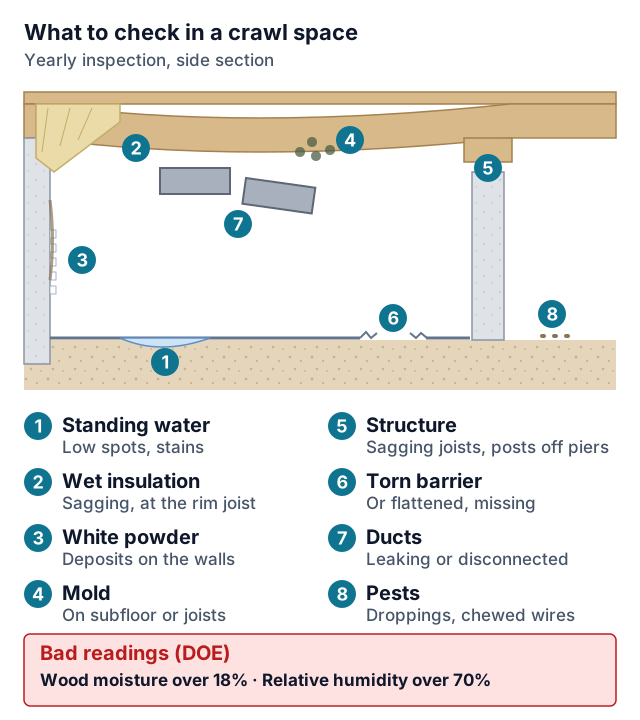
- Check for moisture: standing water, water stains, white powdery deposits on walls, damp insulation, mold, rusty nails or pipes.
- Check the insulation (missing, sagging, wet or discolored, especially at the rim joist) and the ventilation (blocked vents, odors, leaking or disconnected ducts).
- Check for pests (droppings, chewed wires, damaged vapor barrier) and structure problems (sagging joists, sawdust, posts not touching their piers, large cracks).
- Take two readings: wood moisture above 18% is generally bad, and relative humidity above 70% is bad.
- Before calling pros, measure the crawl space footprint (roughly your first-floor square footage) and note any standing water, odors or pest signs.
Do not do this
- Stay out of standing water and don't touch exposed wiring.
- Hire a contractor if you don't feel up to the inspection yourself.
- Don't lay a new liner over standing water, sagging framing or mold. Existing mold should be treated before sealing, otherwise you trap it in.
- Structural repairs need a permit in every market we cover, so leave sagging floors and settling piers to a pro.
What's likely going on
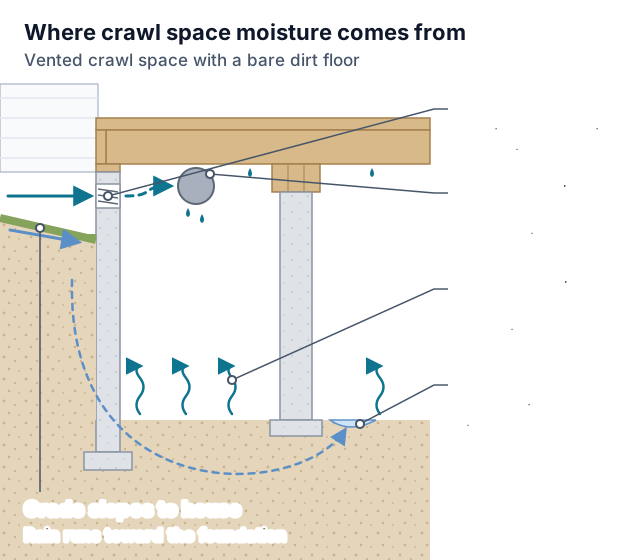
Humid outdoor air coming through open vents
In humid climates, open vents bring in summer air that condenses on cooler ductwork and framing. At Raleigh-Durham, July's average dew point is 68.7°F (NOAA).
Ground moisture with no vapor barrier, or a torn one
Without an intact barrier over the dirt floor, ground moisture evaporates into the space. A torn or flattened old barrier is one of the pest and damage signs DOE lists.
Poor drainage or a shallow water table
Water collects at low spots when grading slopes toward the house or the seasonal water table is high. North Carolina's closed crawl space code (R409) requires a drain to daylight or a sump at each low spot.
Leaking or disconnected ducts and blocked vents
DOE's checklist lists these under ventilation problems, along with odors. They show up as damp insulation, stains or a musty smell near the ductwork.
What it typically costs
Crawl space repair typically runs $4,500–$8,000, averaging $6,000 (Angi); standing water $2,000–$10,000 and structural problems $6,000–$15,000. HomeGuide prices a sump pump at $600–$2,500 installed, drainage at $800–$3,000 and crawl space mold remediation at $1,500–$4,000. An inspection runs $100–$250 (HomeGuide).
Frequently Asked Questions
How often should I inspect my crawl space?
At least once a year, according to DOE's Building America guide. If nothing seems wrong, spring or fall after a significant rain is the best time.
What moisture readings are bad in a crawl space?
DOE's guide says wood moisture above 18% is generally bad and relative humidity above 70% is bad. For indoor air, EPA advises keeping relative humidity below 60%, ideally 30–50%.
Should I fix moisture before encapsulating?
Yes. Fix moisture problems before sealing or insulating. Both Angi and HomeGuide price cleaning and repairs as separate line items; HomeGuide puts them at $500–$8,000.
Can I inspect my crawl space myself?
DOE's guide is written for homeowners, with a gear list and what to look for. It also says to hire a contractor if you don't feel up to it, to stay out of standing water and not to touch exposed wiring.
The service that handles this
Guidance only — independent local providers assess and price their own work. Last reviewed: October 16, 2026.
Sources for the cost figures
- DOE Building America Solution Center: Look for crawlspace moisture issues
- Angi: Crawl Space Repair Cost (Oct 8, 2026) (third-party estimate)
- HomeGuide: Crawl Space Encapsulation Cost (Jan 14, 2026) (third-party estimate)
- HomeGuide: Sump Pump Installation Cost (Aug 26, 2023) (third-party estimate)
- EPA: A Brief Guide to Mold, Moisture and Your Home
- NC Residential Code R409 Closed Crawl Spaces (UpCodes)
Prefer to just talk to someone?
Send the short form — we'll route you to an independent local pro.